
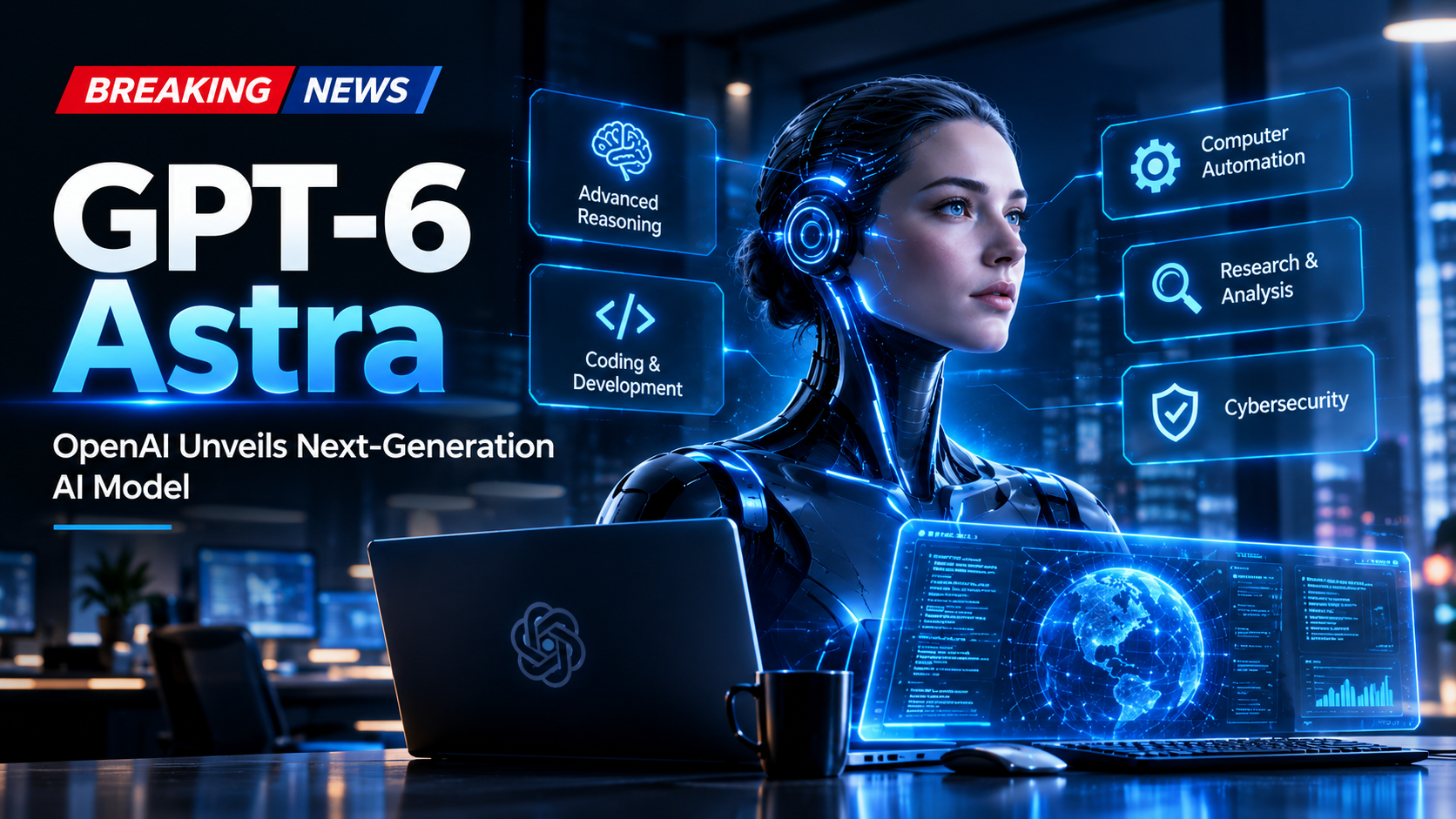
OpenAI has introduced GPT-6 Astra, its latest artificial intelligence model, bringing new capabilities in reasoning, coding, research and computer-based tasks.
New Delhi: OpenAI has announced GPT-6 Astra, a new generation of artificial intelligence designed to handle more complex tasks and perform work that traditionally required human interaction with software and computers.
The launch marks another major development in the global AI race, as technology companies continue to develop increasingly capable AI systems for consumers, developers and businesses.
GPT-6 Astra Focuses on Advanced AI Tasks
According to OpenAI, GPT-6 Astra has been developed to improve the way AI systems reason through complicated problems and complete multi-step tasks.
The model is aimed at applications including software development, scientific research, data analysis, professional work and computer-based automation.
Unlike traditional chatbots that primarily respond to questions, the new generation of AI systems is increasingly focused on taking actions and completing tasks.
Improved Computer-Use Capabilities
One of the notable capabilities associated with GPT-6 Astra is its ability to interact with computers.
AI systems with computer-use capabilities can potentially perform tasks such as navigating websites, working with documents, entering information into applications and managing digital workflows.
This could make AI particularly useful for businesses that rely on repetitive computer-based processes.
Stronger Coding and Software Development
GPT-6 Astra also focuses heavily on programming and software engineering.
The model can assist developers with writing and understanding code, debugging software and handling complex development tasks.
The growing capabilities of AI coding systems could change the way websites, applications and other digital products are developed, although human developers will continue to play an important role in reviewing and managing AI-generated work.
AI for Research and Data Analysis
Another major area of development is research.
Advanced AI models can process large amounts of information, identify patterns and assist users in analyzing complex datasets. These capabilities could be useful across areas such as science, technology, business and education.
However, AI-generated research still requires verification because models can produce incorrect or misleading information.
Cybersecurity Raises New Questions
The increasing capabilities of AI are also creating new challenges around cybersecurity.
More advanced models can potentially assist security researchers in identifying vulnerabilities and analyzing software. At the same time, the same capabilities could create risks if misused.
As a result, AI companies are placing greater emphasis on monitoring, safeguards and responsible deployment of advanced models.
What Could GPT-6 Astra Mean for Businesses?
Businesses are increasingly looking at AI not just as a chatbot but as a tool capable of automating complete workflows.
GPT-6 Astra could potentially help organizations with:
Software development
Data analysis
Research
Document creation
Customer support
Digital administration
Repetitive computer tasks
Business process automation
The actual impact will depend on how organizations integrate AI into their existing systems and how effectively humans supervise automated processes.
AI Industry Moves Toward AI Agents
The GPT-6 Astra announcement comes as the artificial intelligence industry increasingly moves toward AI agents.
Instead of simply answering a user’s question, AI agents are designed to understand a goal, plan multiple steps and use digital tools to accomplish that goal.
This shift could become one of the most important developments in AI over the coming years.
What Happens Next?
The development of increasingly capable AI models is expected to accelerate competition among major technology companies.
The focus is now moving beyond larger language models toward AI systems that can reason, use tools, interact with computers and complete real-world tasks.
For users and businesses, this could create new opportunities for productivity and automation. At the same time, questions surrounding privacy, security, accuracy and human oversight will remain central to the discussion around advanced AI.
GPT-6 Astra represents another step in the evolution of artificial intelligence toward more capable and action-oriented systems. Its impact will ultimately depend not only on technical performance but also on how safely and responsibly the technology is deployed.